El Gran Eclipse
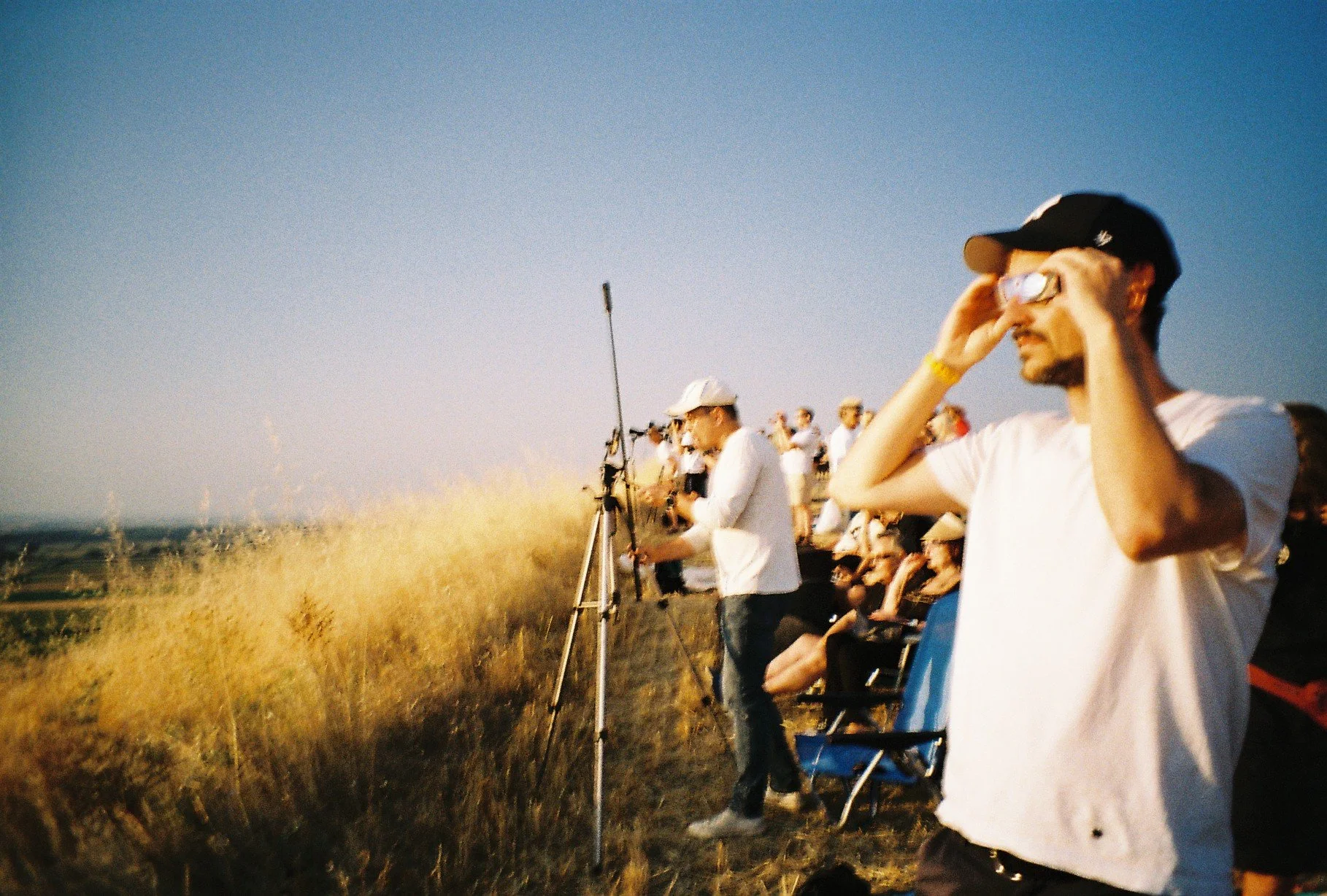
León, Spain (photo: IK)
In the minutes before the moon covers the sun and all the remaining sunrays reaching us filter through the spray of its regolith, our faces are colored in a silvery light. As if we were captured on film that someone had left in a warehouse for too long. Even though only a sliver of the sun remains, you still cannot see with the naked eye that something is obscuring it. Only the color is somehow strange. It grows colder. A tightness grips your soul. And when you turn your back to it, when you see the shadow creeping across the landscape at a tremendous speed, as if the entire horizon were lying on a beach towel over which you are trying to cast the perfect angle of shade with a parasol, it becomes undeniable. We are in space.
Everything that is gargantuan by human standards appears as something a child could handle. Or at least Archimedes, whom you believe for a moment. You truly would need only a long enough lever and a fulcrum to move the world. You can sense, quite physically and bodily, the dimensions of the marbles silently tracing their orbits. The moon's gliding is as if a giant were using a thumb to gauge the distance for us to get a better perspective. The sun, which is otherwise always just a two-dimensional circle in the sky, an imprint of light you cannot look directly into, and whose distance you could never guess off the top of your head (it might as well be a shining hole in the blue, a kilometer above us), is actually somewhere behind the moon. It is four hundred times larger than the moon and, in this cosmic moment of ours, exactly four hundred times farther away.
Over coffee and a newspaper, a person might say, "But how is this possible, such a coincidence?" and ponder an alien intelligence leaving such imposing traces of its presence, clues to help us resolve our uncertain existential experience. But at that moment, during the dance of the giants, when the planet, satellite, and star align, and you sit on the crust of the world as fragile as a cobweb shell, you can only think of one thing: How is it that all this immensity does not disintegrate me?
I had, apparently by pure chance, prepared myself quite well for the experience of a total solar eclipse. This spring I finally picked up the novel MANIAC by the Chilean author Benjamín Labatut. I had heard somewhere that the novel was a blend of Wikipedia articles and a few biographies of great scientists interlaced with imagination, and I developed a prejudice against it. I am annoyed by our contemporary culture that adorns itself almost exclusively in borrowed plumes and is reduced to merely writing footnotes in the margins beneath quotes from authors we all already know, just so that nobody, with their undeserved anonymity, might accidentally dare to say something original. (This is probably also the reason why artificial intelligence gets on most people's nerves: although it lacks original ideas of its own, it is highly capable of replaying, classifying, and qualifying the meager register of ideas that we have decided, in these supposedly free times of ours, are acceptable.)
Regardless, Labatut’s MANIAC is the first novel in a very long time that I read in one sitting. The author admittedly excels most as a curator of the material – wherever he inserts his own voice, he quickly wears out his welcome – but the material he so masterfully selects is so damn interesting that I couldn't put the book down. My brain caught fire: I simply had to know more about it all.
And so I read on. First his other book, When We Cease to Understand the World, and then a pile of popular-science and academic works on quantum physics. I was convinced the subject matter was beyond me, that I simply lacked the brainpower for any fulfilling contemplation on the nature of reality. But it turned out the nature of reality is so very strange, and we know so very little about it, that by, say, the fifth book, I was already arguing with the authors that their thinking on certain matters was wrong. It follows that the difference between someone who knows nothing about quantum physics and Einstein – relative to someone or something that knew everything there is to know about it – is truly minuscule. Even humanity’s greatest thinkers are still merely and helplessly scratching the surface of the miracle that is our existence.
What did I learn, then? It seems that our world appears at the intersection of waves. However, we do not understand whether these waves are something real, or if they are merely possibilities. Imagine it, in a very simplified way, like this: if you wake up in the morning and go to work, you will arrive at work only if you also had the possibility of stopping at a newsstand on the way. It doesn't matter whether you actually go to the newsstand or not; in both cases, you will arrive at work. But, if you headed to work, and the newsstand was closed by inspectors in the meantime, you would no longer be able to arrive at work, even if you hadn't decided to visit the newsstand in the first place. This is roughly how the elementary particles of our reality behave. How on earth could the mere possibility of visiting a newsstand affect your arrival at work?
Only if the possibility undulated in sync with your actuality. And the absence of this wave would degrade your actuality. How is this possible? No one knows. There is a multitude of theories. You, the reader, can develop your own, and it has just as much chance of being correct as mine does (Einstein’s, for instance, failed in experiments). But almost all the theories demand that we change our understanding of the world. To limit ourselves to two: either we are inside a single abstract mathematical space in which we are constantly splitting into a massive number of copies, and our single subjective life is like drawing a single path with a marker along an enormous branch of a tree that holds all our possible lives (which are actually realized in worlds we can never access); from the thick trunk we share with our copies down to the increasingly thin, particular twigs of old age ... or, we are not truly in space at all, and the world appears only as a network of local interactions outside of which there is nothing.
According to the first theory, we, as an elementary particle, took both paths – visiting the newsstand and not visiting it – and arrived at work. But if the newsstand was closed, only half of us arrived at work (the half that didn't visit it on the way). Yet since we are an elementary particle, a half is not enough to oscillate with itself, so nobody arrives. According to the second theory, the question of influence is irrelevant, as there is no objective observer that would allow us to equate different paths to work: the path through the world with a closed newsstand is simply different from the one where it is open, and I will only arrive at work if my network of sequences allows it. The idea that the variable was exactly the newsstand is a mere illusion. Clear, logical, and simple, right? (Physicists will undoubtedly have reservations about this oversimplified explanation; amusingly, their reservations will not be the same.)
Whether we are dealing with a multitude of worlds or a network of interactions: either I – out of all my possible selves, in one of all possible worlds – was present at this exact one of all possible cosmic alignments of celestial bodies (which, statistically speaking, is almost impossible), or the superposition of all my possible local environments satisfactorily resolved into the undulation of a network where the planet, myself, the moon, and the sun were momentarily aligned. Which is, at least from my local perspective, probably an achievement of sorts as well. (If you have had no contact with me, according to this theory, from your local standpoint I wasn't there at all until the moment you read this.)
(photo: IK)
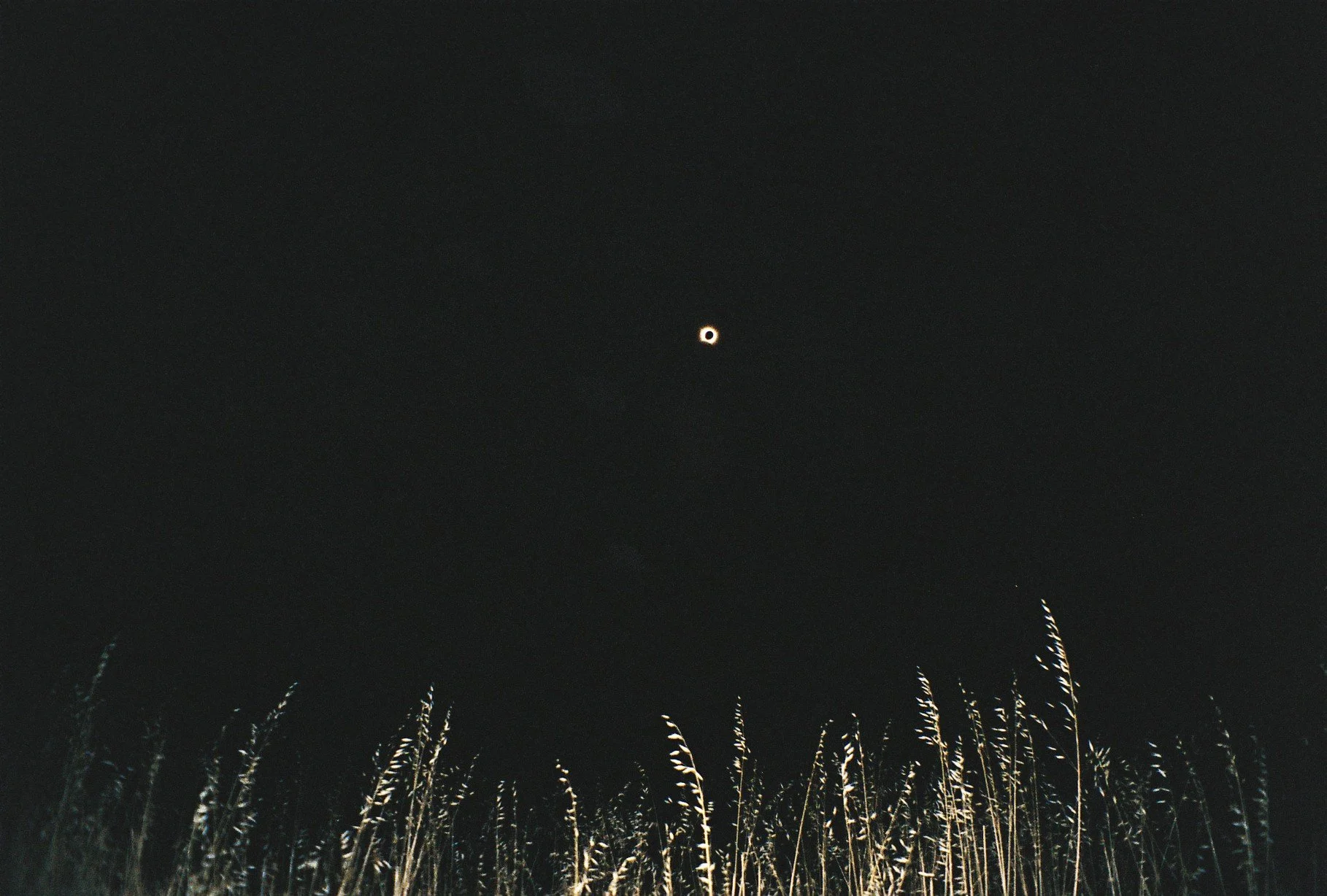
The sun continues to send its robust, blinding sunbeams onto my retinas for a few more seconds before hiding completely behind the moon ... and all physics falls silent. If my eyes were a dead apparatus, they would record: the sphere of the sun is black, the radiation of its rays takes the form of translucent, grainy tentacles caught in a magnetic field, shimmering against the backdrop of the darkness of space, in colors ranging from a turquoise-fringed white to the metallic, saturated yellow of an X-ray image. But since my eyes are the obedient organ of my soul, something unusual is happening to me. I feel as though my consciousness has gazed back upon itself from some unimagined perspective.
While reading the history of physics discoveries in the twentieth century, I often marveled at how philosophically uneducated the great physicists seemed to be. Quantum theory crashed headfirst into the observer problem right at its inception: how is it actually possible that elementary particles behave as particles when someone is looking at them (observing or measuring them), but otherwise behave as waves? Imagine a magical harvester and a cornfield: if you look at it, it harvests row by row; if you look away, it harvests all the rows at once. Any rational farmer would say, "I just won't look at it," and any rational person would say, "There must be something in my gaze that shrinks the harvester down from all the rows to just one."
The physicists were outraged – what is this nonsense about a gaze changing reality? – and immediately declared that the true object of physics was exclusively the one combine in the one row, and in their outrage they went about destroying the careers and lives of physicists who wanted to contemplate the harvesters that nobody was watching. ("Einstein has once again expressed himself publicly on quantum mechanics … As is well known, this is a catastrophe every time it happens,” Wolfgang Pauli wrote to Heisenberg.) Unfortunately, science is also a political discipline, a clique of personalities who fall so deeply in love with their tiny historical moment that they dare elevate their social status above the very nature of reality.
Progress in understanding was thus dependent, as always, on maladjusted geniuses, who were very slowly, reinventing the discoveries of German idealism from the late eighteenth and early nineteenth centuries. Who is the cognizing subject? What is the cognized object? What is the absolute? When measuring the quantum wave of an elementary particle, the measuring instrument itself becomes entangled in its quantum wave, and simultaneously, the person performing the measurement becomes entangled in it as well. When the subject gazes at the object, how is the subject then determined by the object, and how is the object determined by the subject? Where is the boundary between them? Is the whole thing actually a kind of process? The outraged physicists said, "This reeks of dialectics, and surely you aren't going to tell us that the deep structure of reality just happens to resonate with some trendy and suspicious communist theory?"
According to the many-worlds theory (Everett), the harvester goes down different rows in different universes, and when we look at it, we split into as many observers as there are rows, so each of us feels it only went down a single one. The substance of the absolute here is the abstract mathematical space of all realized possibilities, and the moment of the split (decoherence, where one harvester binds to one observer) is the moment of the subjectivization of the absolute (following Hegel; following Heidegger, it would be the moment Being is disclosed as Being-Here). In the theory of a network of local interactions (Rovelli), the magical harvester, when beyond our gaze, is also beyond our physics, harvesting the entire field according to laws inaccessible to us, and our gaze forcefully drags it into an interaction with us where it simply has no choice but to present itself according to the laws governing the boundary contact of our confrontation. Our subjectivized perception is the entire absolute; the disclosed Being-Here is all of Being.
Meanwhile, I am staring into the black sun. I have never experienced my own consciousness in this way. The black sun in the sky has gazed into the black sun behind my eyes. As if I had been momentarily noticed by an otherwise indifferent cosmic being, which was tricked into a fleeting curiosity by the astral oddity of the planetary alignment. I am simultaneously infinitely small – an elementary particle in a vortex of nothingness – and larger than ever before; simply by having the capacity to perceive this phenomenon, I am larger than all the matter that elevated me into this moment. Infinitely estranged, yet never more present. Forever and indelibly recognized as alive.
Up until now, I had always assumed that the emergence of consciousness in apes must have involved some toxic compound from nature, which, upon ingestion, so battered their experience of existence that it subsequently cast a shadow over their recovered and previously unburdened animal minds. So the poor ape was forced to begin questioning, doubting, and finally expressing its newly discovered existential anxiety, whereupon this expression plunged its companions into anxiety as well. But now it seems to me that the experience of a total solar eclipse is perfectly sufficient for such an emergence. It is simply impossible to shake the impression that something deeply meaningful is happening in the sky, and even the most rudimentary rational apparatus capable of gazing at a suddenly darkened sun will be disturbed by the experience and forced to search for some kind of explanation. How is it that all this immensity, which I have witnessed with my own eyes both outside and inside myself, does not disintegrate me?
I hum a melody, carve a bone, press the palm of my hand, covered in clay, against the cave wall. I communicate something. To whom? To myself? To you? To the black sun? Who could possibly be the authority worthy of my address in a world where every particle of matter undulates to the dictates of a probability equation, while local giants arrange themselves into sublime phenomena strictly according to the dialectical key of thesis, antithesis, and synthesis? Where either everything that is possible happens, or exclusively that which comes into contact with me? I feel no closer to the correct answer to this question than that first ape, shrieking in mortal terror when a dark eye fell upon it in the middle of the day.
We can only ever access the world using the tools available to us, whether they be our eyes, our senses, or our conceptual apparatus. Our senses are the product of biological evolution and are roughly the same across individuals, whereas our conceptual apparatus is, at any given moment, the product of history and the evolution of thought in both society and the individual. Had the twentieth century been kinder to human destiny, there probably would have been fewer outraged physicists, as we wouldn't have had to cling so desperately to the mantra of: one row, one harvester, one person, one fate, one ideology, one state, one slave, one master: to victory or a bitter end. Perhaps we could have realized earlier and more lightheartedly that the real world appears at the intersection of the undulations of all its alternatives. The fewer there are, the less real it is. Fewer possibilities, less world. Whoever is afraid of the world will be glad to hear they can have less of it. But whoever wants more of it should, every now and then, toss a coin into the air on a sunny day, let go and surrender to the waves.
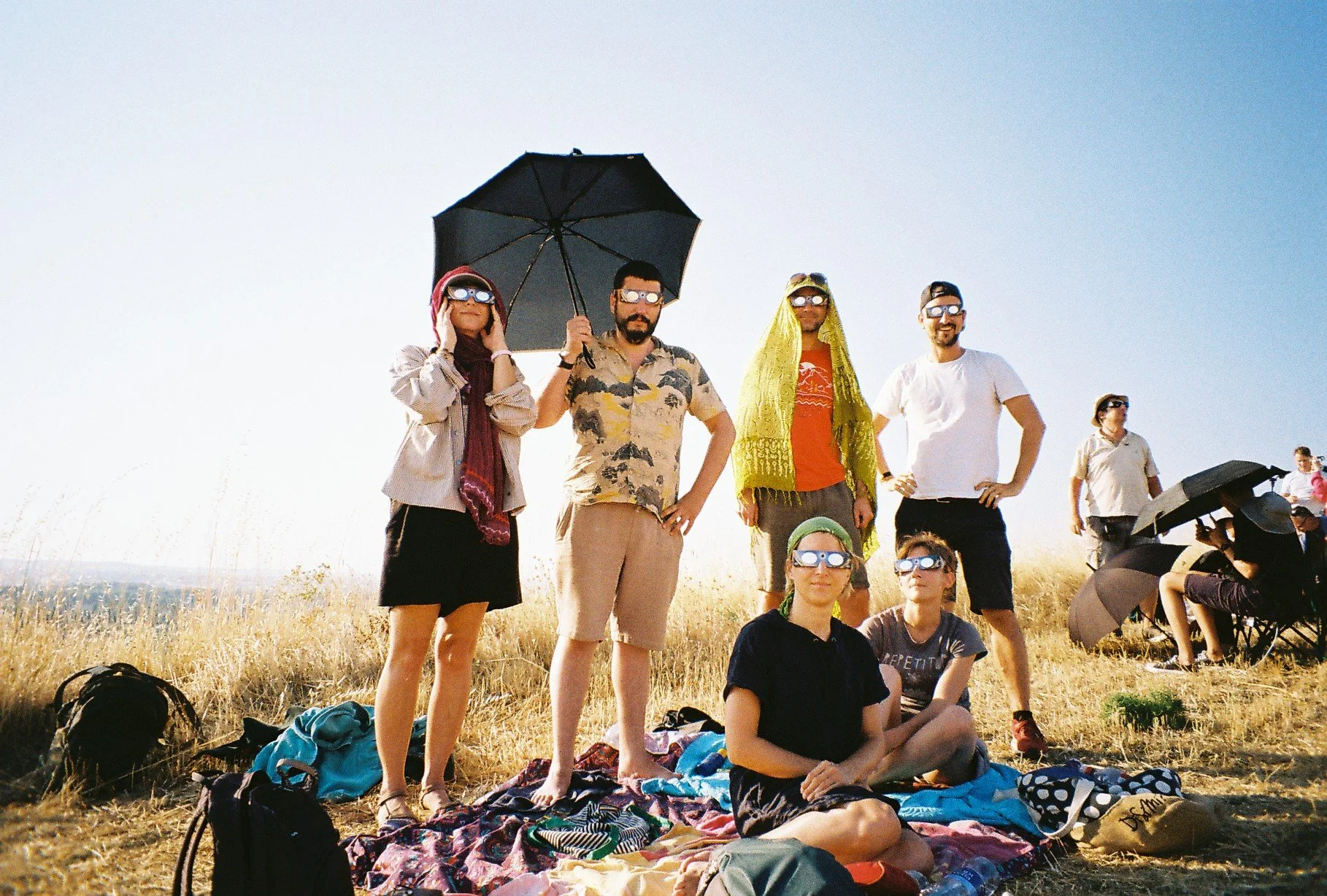
we’re from space
The MANIAC, Benjamín Labatut (Pushkin Press, 2023)
When We Cease To Understand the World, Benjamín Labatut (Cankarjeva založba, trans.: Vesna Velkovrh Bukilica, 2024)
The Many Worlds of Hugh Everett III, Peter Byrne (Oxford University Press, 2013)
What is Real?, Adam Becker (John Murray Publishers, 2019)
Something Deeply Hidden, Sean Carroll (Oneworld Publications, 2021)
Helgoland, Carlo Rovelli (Penguin Books, prev.: Allen Lane, 2022)
Hegel, Terry Pinkard (Cambridge University Press, 2000)
Quantum History, Slavoj Žižek (Bloomsbury Publishing, 2025)